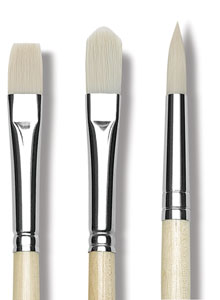
Sunday, December 6, 2020

ARTIST PAINTING BRUSHES :- types of painting brushes

Artist Paint Brushes
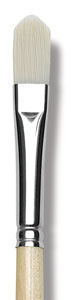
Da Vinci Filbert Brush

The paintbrush will be your magic wand for weaving colors across the canvas. Artist paint brushes become beloved tools the more you use them! As you paint, you will become increasingly familiar with the way the brushes handle the paint and what they can accomplish for you. Pretty soon the paintbrush will become a part of you that you intuitively know how to maneuver.

If you're just starting out in acrylics, it can be a bit overwhelming standing in the paintbrush aisle at the art store, with a vast sea of artist paint brushes spread out before you. The wide selection even makes me dizzy sometimes!

No fear - the Art is Fun Paintbrush Guide is here! This page will tell you everything you need to know in order to select the right paintbrushes to suit your needs.

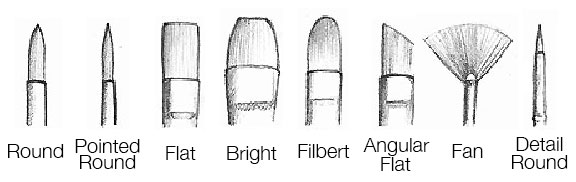
Paintbrushes for acrylics come in many different shapes and sizes. The shapes and sizes of the brushes you choose to work with will depend mainly on how large you want to work, and how detailed you want to get. Take a look:
Paint Brush Shapes

There are 8 main types of artist paint brushes that are used with acrylics, shown above. Each one is specially intended for different uses. Before we get into the particular uses of each paintbrush, let's get a quick low-down of the different parts of the brush:

Get to know your paintbrush

A paintbrush is made of 4 main parts:

Parts of a Paintbrush
  • bristles - also known as hairs. can be natural, synthetic, or combination of both

  • ferrule - the silvery bit that connects the bristles with the handle

  • crimp - the part of the ferrule that secures it to the handle

  • handle - usually made of wood or acrylic

Easy enough! So now that you know the lingo, let's find out what each brush is meant for!

Acrylic Paint Brushes
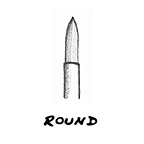
Round Brush

Round or pointed tip.

Good for: sketching, outlining, detailed work, controlled washes, filling in small areas. creates thin to thick lines - thin at the tip, becoming wider the more its pressed down.. use with thinned paint rather than thick paint. 
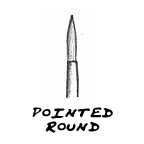
Pointed Round Brush

 Narrower than the round paintbrush. has sharply pointed tip.

Good for: fine details and lines, delicate areas, spotting and retouching. 
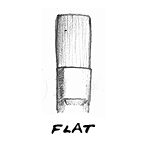
Flat Artist Paint Brush

Square end, with medium to long hairs.

Good for: bold strokes, washes, filling wide spaces, impasto. can use edge for fine lines, straight edges and stripes. long haired flat brushes are ideal for varnishing.
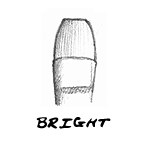
Bright Artist Paint Brush

Flat with edges curved inward at tip, with shortish hairs.

Good for: short controlled strokes. thick, heavy color. better for working up close rather than holding the brush at a distance from the canvas.
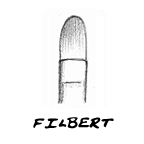
Filbert Artist Paint Brush

Flat and oval-shaped end with medium to long hairs.

Good for: blending, soft rounded edges like flower petals. this brush is sort of a combination of the rounds (because they can be used for detail) and flat (because they can cover more space than round).
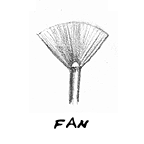
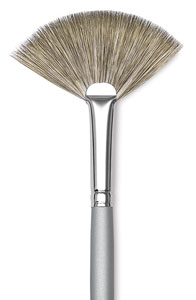
Fan Artist Paint Brush

Flat, spread hairs.

good for: natural hairs are good for smoothing, blending, and feathering. synthetic hairs are better for textural effects, clouds, and leaves on trees. for acrylics, use strong and sturdy one, otherwise the hairs will clump when paint is added.                      
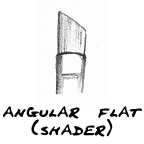
Angular Flat Artist Paint Brush

Flat with angled hairs at end.

Good for: curved strokes and filling corners. can reach small areas with tip. also can be used to cover lots of space, similar to flat brushes.
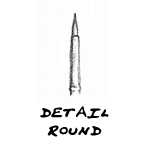
Detail Round Artist Paint Brush

Round, hairs shorter in length. shorter handle.

Good for: details and short strokes. holds more color than you might think!

I've provided links below to the relevant products so that you can easily find them on Blick Art Materials, my favorite online art supplier. I'm a member of Blick's affiliate program, which means if you make a purchase after clicking on one of these links, I'll receive a small commission (at no extra cost to you).
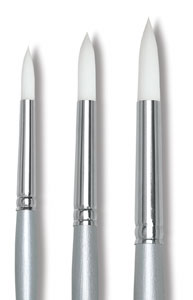
Paintbrush Sets

The products below are available on Amazon. As an Amazon Associate I earn from qualifying purchases.

If you're a beginner it can be helpful to get all your brushes at once in a set. I'm a fan of these two sets below: the Maestro Series XV and the Minute Series XII. The Maestro Series VX brushes are a great all-around set because they include a variety of brush shapes and sizes (flat, round, filbert, etc). The Minute Series XII brushes are ideal for painting small details. If you're just starting out I'd suggest getting the Maestro Series XV first, and then if you find that you want to paint more details, the Minute Series XII brushes would make a great addition to your collection of brushes. I've used both sets with acrylics, watercolors and gouache and am very happy with their performance.

Maestro Series VX Brushes
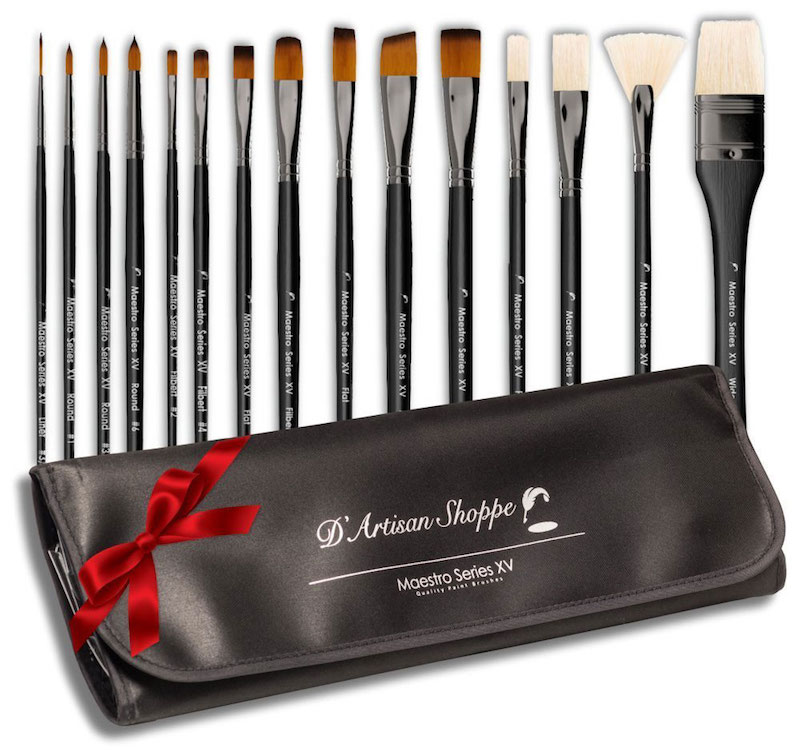
Maestro Series VX Brushes

Minute Series XII Brushes
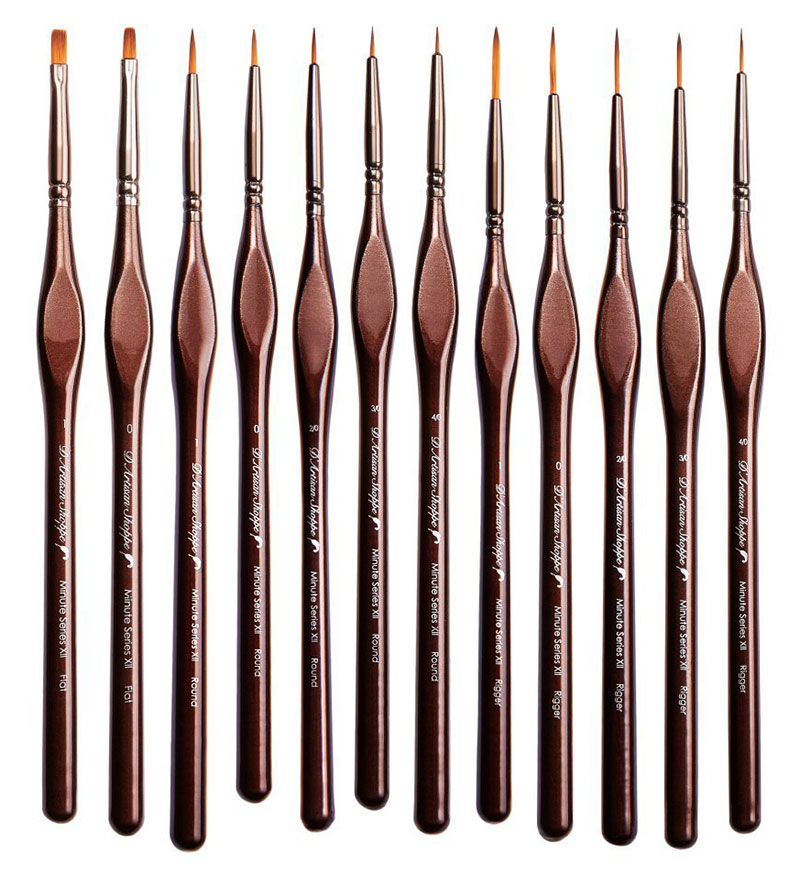
Minute Series XII Brushes

Monday, November 30, 2020

PRINCIPLE OF PERSPECTIVE :- Part -1

In this, I'll make you learn the basic of perspective, we'll divide this topic into 2 Or more chapters. So, stay connected 😊


PERSPECTIVE   

In order to have an accurate selection of the objects we must have some knowledge of the principle of perspective. Different object at different position of different place do not look alike. We must observe the place and position of the object that we are going to draw. 

Only the upper part of the object which is under the level of the eye will be visible and the lower part will be so distinct. This object looks straight on the eye level and only the lower part and not the upper part of the objects above the level of the eye will be visible clearly. This is illustrated or below the eye level, but a straight line would only be visible at the level of the eye. 
Even the object alike does not look equal on their being far and near distant. 
The distant object gradually becomes smaller and smaller. If a distant object reaches at the eye level, it is reduced to a point. 

*Eye  level

This is an imaginative horizontal line which is exactly at the same height of the Spectator's eye from the ground level, where he is sitting and standing as shown in figs (I) . 

(I) 

Every perspective has an eye level and vanishing point always lies on the same eye level. 

THIS IS A SIMPLE EXAMPLE OF ONE POINT PERSPECTIVE. 


In the next chapter of perspective , we'll learn something more and more about it. Which will help you to draw something exciting. 

See you guys 
Love you all


Inspired by mamana m mehta
Book:- step drawing

Sunday, November 29, 2020

PRINCIPLE OF ART

^There are some basic principle of art we made to simplify art. 

1. LINE 
   A path that join two points is called line. Line is most important part of art because to create any form, design, drawing, art work, we start with line that draw our idea or imagination. 

  There are some variety of lines are shown. 
1. . .  . . . . . . . . . . . Dotted line
2.- - - - - - - - - - - - broken line
3._________________ straight line
4. 〰〰〰〰〰〰〰〰 Curve or zigzag line


2. PENCIL SHADING


3. FORM  AND  SPACE
      FORM
     Any object's dimension drawing is called form, it includes heights, width and depth. 
 

    There are two types of form:-
1. Symmetrical Form :- if we divide any form into two parts equally and one part is the mirror image of another then form is symmetrical. 

2. Asymmetrical Form :- if any part of the form does not match with another then the form is asymmetrical. 

Meaning of different forms

1. Rectangular form     :      Strength and Unity
2. Triangular form    :     Evolution and Direction
3. Circular form     :     Equality  and motion
4. Oval form       :       Creativity and motion

SPACE 
Any composition has two basic element name form and space. Apart from the form rest is space. Space is also known as breathing space or negative space. 


COLOURS
Colour is known as Hue. Colour is divided into various categories. 

A. Primary colours :- RED, YELLOW, BLUE  are primarycolours

B. Secondary colours:- green, purple, orange are secondary colours. They are obtained by mixing two primary colour. 

C.Tertiary colours :- when we mix primary and secondary colours, we get tertiary colours. 


GRAY SCALE
This is not a colour but tone, Gray is a mixture of black and white. 


Monochromatic:-
Monochromatic is a kind of color scheme in which we use single colour and to give dark and light tone, we mix white and black accordingly. 


WARM COLOUR :- 
Warm colour are the colour of fire and sun i.e. Red, Orange, Yellow, Brown etc. 


COOL COLOUR :- 
Cool colours are the nature colours i.e. Blue, violet, green, etc every colours we see in nature.

*LIGHT  &  SHADE 

1. LIGHT :- The part of any object which is in light 

2. HIGH LIGHT :- Very brilliant part of an object. The part of an object which is in more brilliant light is different from the part that is in less brilliant light. 

3. SHADE :-  The position in which the part of an object is sheltered from light. 

4. CAST SHADE :- The shadow of any object .The shadow reveals the shade of an object and also the surface on which it falls. 

5. TONE:- The shade of a colour : The Paleness or the Deepness of a colour. 
Tone is used for modeling or depicting roundness of objects as the Lightness or darkness or a local colour (original colour) as making layout by light and shade. 
Chiaroscuro and to render or portraying the effect of lighting conditions. 

6.HALF  TONE :- A condition of deep light (not brilliant light) . The part of an object which is not in the direct direction of light but is in the position where light is less brilliant. 


This is inspired from Mamana M Mehta Mam
Book:- steps drawing book

Thursday, October 4, 2018

Eyes sketck :- tutorial video

                        Eyes sketck

Hello buddies,
      In this vlog ,I just show you my eyes sketck video. To show how can you draw eyes or other things. Before starting ,guys follow my page and like , comment ✌️..

Let's start....
 
Must watch it,

Thank you
Jai Hind 🇮🇳🇮🇳
Jai Bharat

Wednesday, October 3, 2018

5 drawing mistakes of beginners.

       5 drawing mistakes by the      beginners.

1}##   Don't draw cartoon character.
      Some people draw cartoons. According to me , you should not draw cartoons if you want to be an artist or you are highly passionate about arts then don't draw cartoons because you learn nothing by draw cartoons .as we know that cartoons are complex , zig zag etc. And different types of shape which there is no need in sketcking.

But if you draw portrait, figures, human faces then you will learn so many things from it.

## don't draw cartoons, but you should watch cartoons and observe the background and it's colors.

2}##.  If you are beginners then you have a less knowledge towards sketch (don't disappointed)like shading, blending, depth,prespective etc .

All the buddies, directly use the brushes . they don't use pencil for practice.

##1st of all , you should do practice by pencils.when your holding capacity of your pencil is good then you should draw by brush or another things.

###if you draw best by pencil then brush painting will so easy for you ..


3}##.  Don't copy any Sketcher, don't try to copy his/her style like pencil holding, drawing style etc,all the methods of drawings style of different types of Sketchers is different.

So, try to make your own style.
Try to hold the pencil as you want,as you comfortable.

Do experiment with your sketck, creat new styles,as people copy you.

4}##.  Beginners never observe their final sketckes, don't compare the sketckes with the original one, only try to find mistakes,like:- eyes,nose, lips, eyesight,eyes brow,hairs,beards,mouche etc..

∆∆∆ don't satisfy with your sketckes only feel satisfraction that you try to draw a human face , you learn so many things to draw this or that...

5}##.  The last and most IMPORTANT thing ,. :-

You  should respect all the artist.🤗🤗🤗

So,. The end
       Jai Hind 🇮🇳🇮🇳
       Jai Bharat

Friday, September 28, 2018

How to draw eye

                   How to draw eyes

As we know that eyes is an important sense organ in living organisms,

It is also important to make your sketch much realistic and attractive.
Let's go😎😋
 1} To draw realistic and attractive eyes , you should do practice for curve lines and zig zag lines
2} pencils should be sharp.
3} As we know that in our eyes there is lot of colors .so. we use different types of pencils for different areas (like , eyesight- charcoal pencil, dark areas and light areas by graphite pencil of 6B or 9B to 10B by controlling the pressure .
4} must notice the expression of the face of the pic what you draw, eyes can say everything..
5} don't discouraged if you can do it perfectly..


This eyes show different types of emotions in human(like- angry,sad,shock, happy and constant or normal...


The most important thing when you draw anything, according to me , when I draw eyes,nose, lips, hairs, eyesight, braids,mouche,etc .I first zoom the picture as I want to draw on page( means :- the zoom size of picture and what you draw is same)

So,guys keep sketcking, practicing as much as  possible,as we know that practice makes everyone perfect.

So, good bye
      Jai Hind 🇮🇳🇮🇳
      Jai Bharat

Thursday, August 16, 2018

Basic sketcking components for beginners.

Sketcking components for beginners

Some sketcking accessories or components which is mainly use by beginners as well as professionals.

1} Mechanical pencil of 0.5 mm or 0.7 mm which is use for outline in you sketch,it is easy to erase.

2} pencil - 6B for shadow effects.
                  -9 B and 10B for hairs.

3} charcoal pencil :- For dark areas. There are 3 types of charcoal pencil .1)hard charcoal pencil 2)soft charcoal pencil 3) very short charcoal pencil.but soft charcoal pencil ,you can use in every place..

4} pencil stumps:- For shading, you can use tissue paper or painting brush,(but don't use your thumbs or fingers for shading).

5} Zero mono eraser or tombo eraser:- it use to erase the small detailing or to create a shine appearance or to erase small areas.

6} drawing sheets:- according to me ,I use ivory A4 paper for sketcking and it is best for sketcking,it has a smooth paper and easy to sketch on it.
CARAN D'ACHE GRAPHITE LINE GRAFWOOD ARTIST EXTRA FINE DRAWING PENCIL (9B) https://www.amazon.in/dp/B01KKN0Q96/ref=cm_sw_r_cp_apa_i_rfODBbF03123Z
Apsara Glass Marking Pencils, White - Pack of 10 https://www.amazon.in/dp/B00S9BL1P0/ref=cm_sw_r_cp_apa_i_YgODBb5JBA218

Camlin Kokuyo Medium/Soft/Hard Charcoal Pencils https://www.amazon.in/dp/B00LY1F752/ref=cm_sw_r_cp_apa_i_LiODBbRGRDMKK

SoKabeer Art Paper Stump (Set Of 6Pc0 https://www.amazon.in/dp/B011A0FNOQ/ref=cm_sw_r_cp_apa_i_okODBbCXJZCHG
Shipra Ivory Sheets, 11.5 inches x 8.5 inches x 0.1 inch, 25 Sheets https://www.amazon.in/dp/B01KXG5C5I/ref=cm_sw_r_cp_apa_i_VlODBbB55MTMX
 Kokuyo Coloree 0.7mm Mechanical Pencil with Lead https://www.amazon.in/dp/B072NBT4K1/ref=cm_sw_r_cp_apa_i_snODBbT2BARJT

 guys these are some components which is use to sketch real view .

So keep sketcking 
All the best to you guys.
God bless you.